How to Boil Eggs Perfectly Every Time
Boiling an egg sounds like the easiest thing in the world, until you have chopped into a grey, rubbery yolk one morning and a runny, teary white the next. I have done both, more times than I would like to admit, and for years I thought good eggs were a matter of luck. They are not. There is a simple method, and once you know it, you will have perfect eggs every single time.
The trick is not to boil the egg at all — not really. You bring the water to the boil, then you turn the heat off and let the hot water do the work while you time it. That is the whole secret, and it works whether you like your eggs soft and jammy or firm all the way through. Here is how to get it right, every time.
Watch: How to Boil Eggs Perfectly Every Time
Reading time: 5 minutes | Skill level: Beginner | Tools: A saucepan, a timer and a bowl of cold water
1. Start with the Right Eggs
Older eggs peel more easily than very fresh ones, because the white loosens from the shell as the egg ages. Use eggs that are at least a few days old, and take them out of the fridge a little before cooking — cold eggs dropped into hot water can crack. If your eggs are straight from the fridge, run them under warm water for a minute first.
2. Put the Eggs in Cold Water
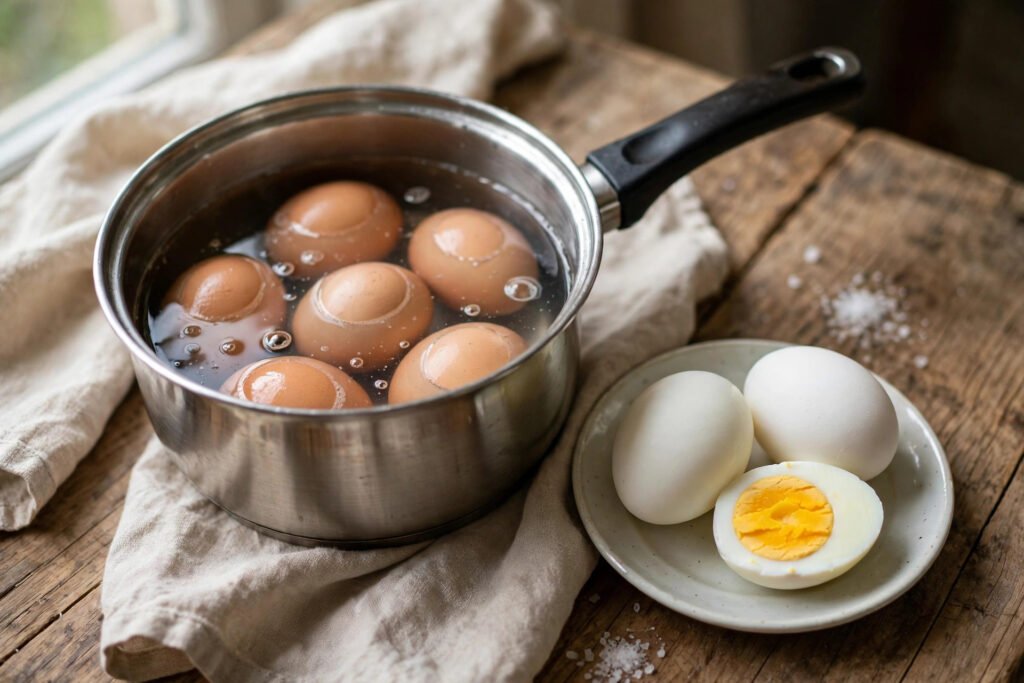
Put the eggs in a saucepan in a single layer, with enough cold water to cover them by about two centimetres. Do not stack them or crowd them — eggs that bang into each other crack, and cracked eggs leak white into the water. A single layer means every egg cooks at the same speed, and cold water brought up to heat gently is far kinder to the shells than dropping them into water that is already boiling.
3. Bring It to a Boil, Then Turn It Off
Bring the water to a full boil over a medium-high heat, and as soon as it is bubbling hard, turn the heat off completely and put the lid on. This is the bit most people get wrong — you do not boil an egg for ten minutes. The hot water, held in the pan under a lid, cooks the egg gently and evenly, without the violent bubbling that cracks shells and turns the yolks green.
4. Timing Is Everything
Now set a timer, because this is where perfect eggs are made. For soft, jammy eggs, 6 minutes. For a set white and a soft, golden centre, 7 minutes. For a fully set yolk that is still creamy, 9 minutes. For a firm, hard-boiled egg, 10 minutes. These times work for a large egg; take a minute off for small eggs and add a minute for very large ones. And write your favourite time down — the first time you get it right, you will want to remember it.
5. Stop the Cooking with an Ice Bath
When the timer goes off, move the eggs straight into a bowl of cold water, ideally with ice in it, and leave them there for at least 5 minutes. This stops the cooking instantly — if you leave them in the hot water, they keep cooking and the yolk goes dry and chalky. The cold water also makes the eggs easier to peel, because the shell contracts away from the white. Do not skip this step; it is the difference between a good egg and a great one.
6. Peel Them Easily
Tap the egg gently on the counter until the shell is cracked all over, then roll it under your palm to loosen the shell. Start peeling from the wide end, where the air pocket sits, and peel under running water or in a bowl of water — the water gets under the membrane and helps the shell come away in big pieces. If the shell sticks, the egg may have been too fresh, so use older eggs next time.
Storing Boiled Eggs
Boiled eggs keep in the fridge for up to a week, in the shell or peeled in a container of cold water. Keep them in the shell if you can; the shell protects them and they stay fresher. Peel them only when you are ready to eat them, and if you peel them early, change the water every day. Do not freeze boiled eggs — the white turns rubbery and strange. A boiled egg in the fridge is a ready-made snack, a lunchbox favourite and the start of many good things.
Tips
A few things I have learned along the way. Add a teaspoon of vinegar or salt to the water; it helps the white set quickly if an egg does crack. Never overcrowd the pan — one layer of eggs, plenty of water. Use a timer every single time; guessing is how twelve minutes happens. And if you get a green ring around the yolk, the egg was cooked too long or cooled too slowly — it is still perfectly safe to eat, it just looks a bit grey. To test whether an egg is hard without peeling it, spin it on the counter — a hard egg spins quickly and smoothly, while a raw or soft egg wobbles.
That is all there is to it: cold water, one boil, a lid and a timer, and you will have perfect eggs every morning. Once you know your number — mine is seven minutes for a soft centre — you will never have a rubbery egg or a raw white again. If you try it, tell us on our Contact page what time worked for you; we love hearing what home cooks learn from the guides here. A perfect egg is a small thing, but it makes a good morning.