Beginner Guide to Baking Measurements
My first cake came out like a brick. My second batch of cookies spread into one giant pancake that covered the whole tray. For a long time I thought I just was not a baker, that some people had a feel for it and I did not. Then a friend watched me make a sponge and asked one question: how are you measuring the flour? I was scooping it straight from the bag with a coffee mug, and that was the whole problem.
Baking is closer to chemistry than cooking. In a stew you can add a little more or less and it will still be dinner, but in a cake the ratios are what make it rise, stay moist and hold together. The good news is that measuring is easy once you know a handful of rules, and none of them needs fancy equipment. This guide covers the ones that made the biggest difference in my kitchen.
Reading time: about 5 minutes | Skill level: beginner | Tools: a kitchen scale, measuring cups and spoons, a measuring jug
Watch: Beginner Guide to Baking Measurements
Weigh It When You Can
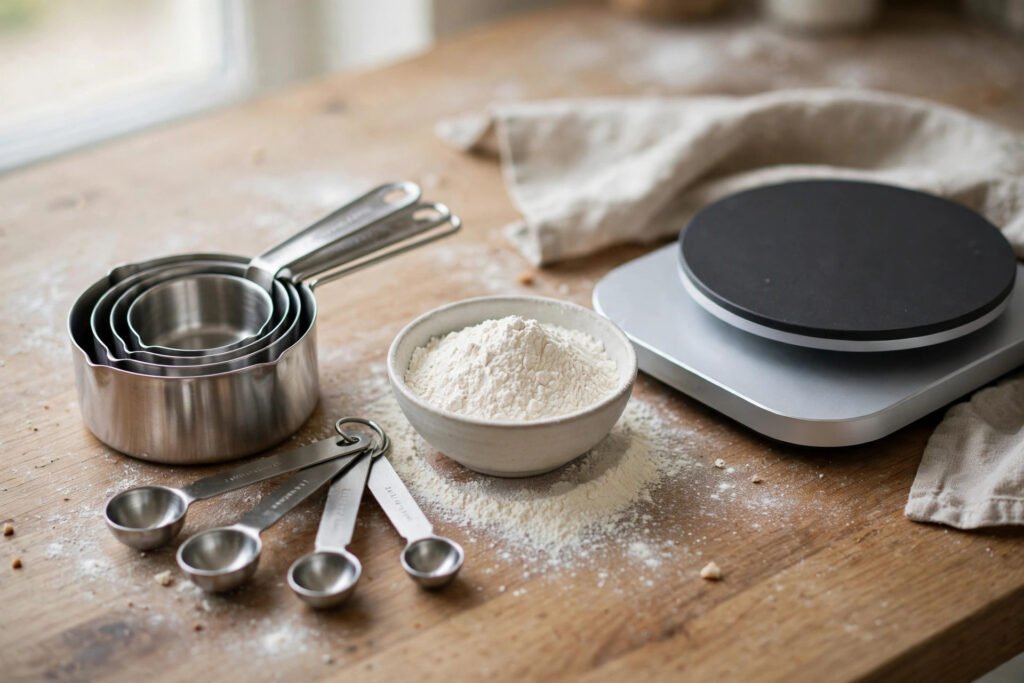
A kitchen scale is the best purchase a beginner baker can make, and it costs less than a bag of flour. Weighing is exact: 200 grams is 200 grams, every time, in every kitchen. A cup of flour, on the other hand, can weigh anywhere from 120 to 160 grams depending on how you fill it, which is the difference between a light sponge and a brick. If a recipe gives grams, use them. Turn the scale on, put the bowl on it, set it to zero, and add your ingredients one at a time.
Spoon and Level the Flour
If you do use cups, never scoop the flour straight from the bag. Scooping packs the flour down, so you end up with far more than the recipe means. Instead, spoon the flour loosely into the cup until it is heaped, then sweep the back of a knife across the top to level it off. It takes ten extra seconds and it is the difference between a cake that rises and one that does not.
Know Your Cup Sizes
Not all cups are the same size, and this catches people out. An American cup holds 240 millilitres and an Australian metric cup holds 250, while a British cup is often 284. Ten millilitres here and there does not sound like much, but across a whole recipe it adds up. Pick one set of measuring cups and stick to it. When in doubt, trust the grams — they never change.
Measure Liquids at Eye Level
Liquids are measured in a jug, not a cup, and the trick is to read the level at eye level. Set the jug on the counter, pour in the milk or oil, then bend down until your eyes are level with the liquid and check the line. Reading it from above makes the level look lower than it is, so you pour in too much. Watch for the curve at the surface and read the bottom of it. A splash too much water in bread dough turns a firm dough into a sticky mess.
Spoons Are Not the Same
Measuring spoons matter more than people think. A tablespoon of baking powder is not a rough guess: too little and the cake stays flat, too much and it tastes bitter and collapses. Use proper measuring spoons, not the spoons from your cutlery drawer, which are all different sizes. Level them off with a knife, the same as flour. A teaspoon is 5 millilitres and a tablespoon is 15 — three teaspoons make a tablespoon.
Butter, Sugar and Eggs
Butter is easiest weighed, because most packets have grams marked on the wrapper — just cut where it says 100 grams and you are done. Brown sugar should be packed firmly into the cup when a recipe says packed, and scooped loosely when it does not. Eggs are the one thing you do not weigh: crack each one into a small bowl first, then add it to the mixture, so a bad egg never ruins a whole cake and you can fish out any shell.
Write Down What You Did
The last habit is the one that turns a good bake into a repeatable one: write down what you did. Note the oven temperature you actually used, how long it really took, and any change you made — a little less sugar, a bigger tin, a different flour. Recipes were tested in someone else’s kitchen and oven, so yours will always be slightly different. My notebook has a page for every cake I bake, and it is why my lemon drizzle works every time now.
Tips
Measure everything before you start — bakers call it mise en place — so you are not scrambling for the baking powder while the oven is hot. Use the same scale and the same cups every time, so your results stay consistent. And if a bake fails, do not bin the recipe: taste it, look at what went wrong, and change one thing next time. Flat cake, too much flour. Dry cake, too long in the oven. Every failure is a lesson with a tasty ending.
Baking measurements are not fussy rules. They are the reason a recipe works in your kitchen the way it worked in the writer’s, and once you have them down, baking gets easier, not harder. Weigh when you can, spoon and level when you cannot, and write down what worked. Do that, and the cakes will start coming out the way you hoped — and the only surprise left will be how good they taste.